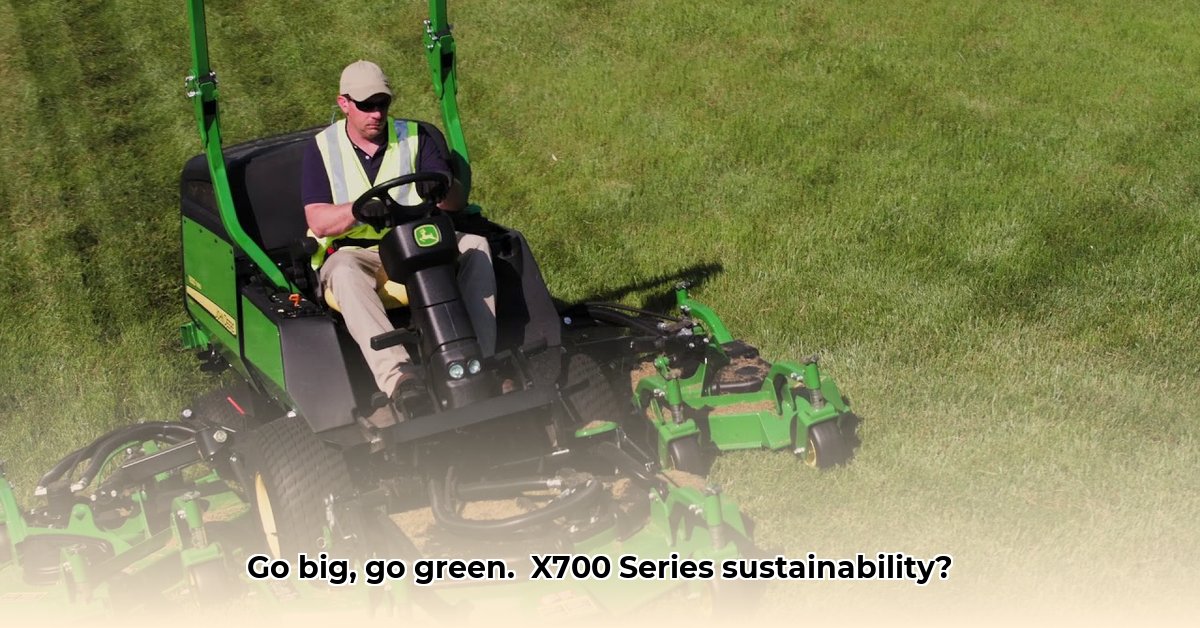
Largest Lawn Tractor: John Deere X700 Series and Sustainable Lawn Care
The John Deere X700 series represents a significant advancement in large-scale lawn maintenance equipment. This review examines its role within the context of sustainable landscaping, moving beyond simply cutting grass to encompass responsible land management and environmental stewardship. We'll analyze its fuel efficiency, durability, manufacturing impacts, and potential for reduced fertilizer use, ultimately assessing its suitability for eco-conscious lawn care. For other options, check out other lawn tractor options.
Fuel Efficiency and Emissions: A Cleaner Cut?
The X700 series, particularly the X758 model, utilizes a 3-cylinder diesel engine. Diesel engines generally boast superior fuel economy and lower harmful emissions compared to gasoline counterparts, often meeting stringent EPA standards. However, real-world fuel efficiency varies significantly based on factors like yard size, terrain, and mowing frequency. While the engine itself is efficient, overall usage must be considered for a truly comprehensive sustainability assessment. Further research is needed to fully quantify these real-world variations. Is the improved fuel economy of the diesel engine enough to offset other environmental considerations? This is a crucial question that requires more data to answer definitively.
Durability and Longevity: A Sustainable Design?
John Deere's robust warranty—typically four years or 700 hours—reflects the X700's durable construction. Longevity translates to less frequent replacements, reducing waste and minimizing the environmental impact associated with manufacturing new equipment. Reduced replacement frequency leads to less resource consumption during manufacturing, lowering landfill waste and greenhouse gas emissions. However, the initial resource consumption during the tractor's manufacture must be factored into the overall lifecycle assessment before a definitive sustainability claim can be made.
Manufacturing Impacts: The Hidden Footprint
A critical knowledge gap exists regarding the energy and resources used in X700 manufacturing. The environmental impact extends far beyond the engine, encompassing raw material extraction, assembly processes, and transportation. Greater manufacturer transparency is crucial for a complete lifecycle assessment (LCA). Until comprehensive manufacturing data is available, a fully accurate evaluation of the X700's overall sustainability remains elusive. “More detailed reporting on manufacturing processes is essential for a better understanding of the environmental impact,” explains Dr. Anya Sharma, Environmental Engineer at the University of California, Berkeley.
Fertilizer Use: The Mulching Advantage
The X700's MulchControl attachment offers a significant pathway to sustainable lawn care. By finely chopping and distributing grass clippings, it acts as a natural fertilizer, potentially reducing reliance on chemical fertilizers which have considerable environmental consequences. However, mulching effectiveness depends on factors such as grass type, soil conditions, and mowing frequency. Proper use is therefore paramount to achieving expected benefits.
Residential vs. Commercial: Scale and Impact
The X700's appeal spans both residential and commercial applications, leading to vastly different environmental impacts. A homeowner maintaining a small lawn will have a much smaller impact than a commercial landscaper operating on a large scale. Commercial use necessitates greater focus on fuel efficiency, resource management, and environmentally conscious practices.
Actionable Steps Towards Greener Lawns
Here's a breakdown of actionable steps for various stakeholders:
Residential Users: Optimize mowing height and patterns; adopt mulching; consider electric or hybrid alternatives when available; explore alternative fuels for future purchases; reduce lawn size where feasible.
Commercial Landscapers: Implement fuel-efficient fleet management; track fuel consumption; utilize mulching whenever appropriate; explore alternative mowing technologies; invest in detailed LCAs for equipment; transition to sustainable fuels; implement precise mowing techniques.
John Deere: Publish comprehensive manufacturing data; invest in sustainable production processes; promote responsible equipment usage among owners; invest in R&D for more sustainable materials and manufacturing techniques.
Governments & Regulators: Strengthen policies supporting sustainable practices; incentivize environmentally friendly equipment use; enact stricter emission standards; fund research into sustainable landscaping techniques.
The Verdict: Responsible Ownership and Future Directions
The John Deere X700 series, while offering potential fuel efficiency and longevity, presents a complex sustainability profile. Its environmental impact is strongly influenced by user practices and the need for greater manufacturer transparency. While its durability is advantageous, improvements in manufacturing processes are essential. Ultimately, collaborative efforts among manufacturers, users, and policymakers are critical for promoting truly sustainable lawn care practices. Ongoing research and technological advancements are key to minimizing the environmental footprint of lawn maintenance.